
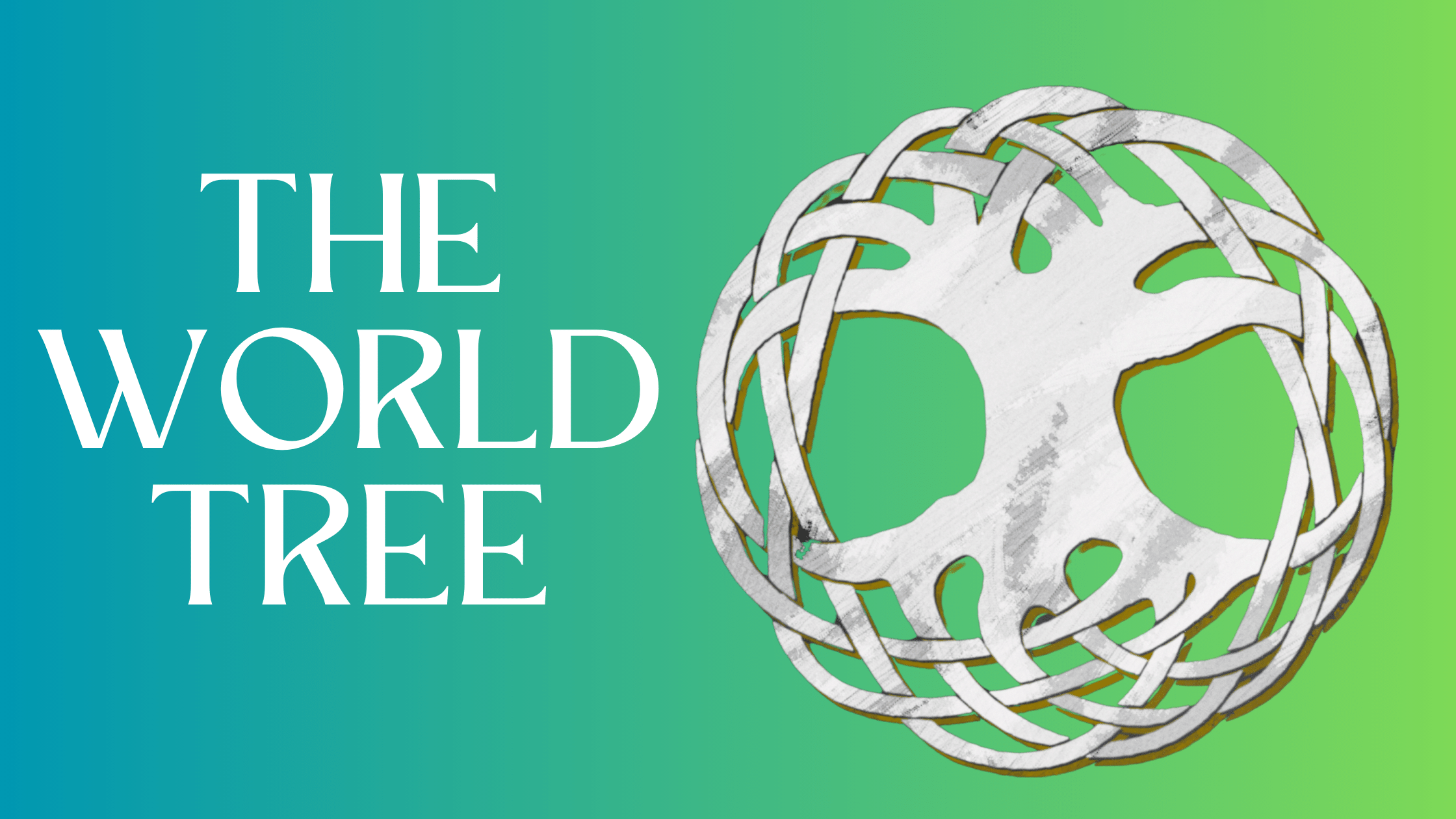
The world tree is a powerful symbol that appears in many religions and mythologies, especially among the Indo-European peoples. The world tree represents the cosmic order, the connection between the heavens, the earth and the underworld, and the source of wisdom and life. I will explore discuss some examples of how the world tree was conceived and revered by different ancient European cultures, such as the Norse, the Germanic, the Celtic, the Slavic, the Baltic, and the Finnish.
The Norse World Tree: Yggdrasil
One of the most famous examples of the world tree is Yggdrasil, the immense ash tree that stands at the center of the Norse cosmos. According to the Prose Edda, a 13th-century collection of Norse myths, Yggdrasil has three roots that reach into three different realms: Asgard, the home of the gods; Jotunheim, the land of the giants; and Niflheim, the realm of ice and mist. At the base of each root, there is a well or a spring that holds a secret knowledge: Urd’s Well, where the Norns (the fates) weave the destiny of all beings; Mimir’s Well, where the god Odin sacrificed one eye to gain wisdom; and Hvergelmir, where the dragon Nidhogg gnaws at the root.
Yggdrasil also has nine branches that correspond to the nine worlds of Norse mythology. The highest branch reaches into Asgard, where Odin’s hall Valhalla is located. The lowest branch extends into Hel, the underworld where the dead dwell. Between them are Midgard, the world of humans; Alfheim, the world of elves; Vanaheim, the world of fertility gods; Svartalfheim, the world of dwarves; Muspelheim, the world of fire giants; and Nidavellir, the world of dark elves. On top of Yggdrasil sits an eagle that represents the sky, and between its eyes is a hawk named Vedrfolnir. At the bottom of Yggdrasil is a serpent named Jormungandr that encircles Midgard and represents the sea. The eagle and the serpent are enemies and exchange insults through a squirrel named Ratatosk that runs up and down the tree.
Yggdrasil is not only a physical structure but also a living being that suffers and bleeds. It is constantly under attack by various creatures that try to damage it: Nidhogg and other serpents at its roots, four stags that eat its leaves, and countless insects that bore into its bark. The gods try to protect and nourish Yggdrasil by sprinkling it with water from Urd’s Well every day. Yggdrasil is also a source of oracles and visions for those who seek them. Odin hanged himself from one of its branches for nine nights to learn the secrets of the runes, and Heimdall, the watchman of the gods, can see everything that happens in the nine worlds from his seat at the top of Yggdrasil.
The Germanic World Tree: Irminsul
Irminsul was a sacred symbol of the Saxons, an ancient Germanic tribe that lived in northern Europe. Irminsul means “great pillar” in Old Saxon, and it was a pillar-like object that represented the center of the world and the connection between heaven and earth. Some sources describe Irminsul as a tree trunk erected in the open air, while others suggest it was a stone structure or a tower.
Irminsul played an important role in the Germanic paganism of the Saxons, who worshipped it as a symbol of their god Irmin. Irmin was possibly an aspect or epithet of Odin, the chief god of the Norse pantheon, who was also known as Jörmunr or Yggr. Odin sacrificed himself on Yggdrasil, the cosmic tree that connected the nine worlds in Norse mythology. Yggdrasil and Irminsul may have been related concepts, as both were seen as world trees that sustained the universe.
Irminsul was located near Heresburg (now Obermarsberg) in Germany, where it was a site of pagan rituals and sacrifices. However, in 772 AD, during the Saxon Wars, Irminsul was destroyed by Charlemagne, the king of the Franks and a Christian convert. Charlemagne wanted to spread Christianity among the Saxons and eliminate their pagan beliefs. He ordered the demolition of Irminsul and built a church in its place, which was blessed by Pope Leo III.
The destruction of Irminsul was a major blow to the Saxon culture and religion, and it marked the beginning of their forced conversion to Christianity. Irminsul remains a mysterious and fascinating symbol of the ancient Germanic worldview and spirituality.
The Celtic World Tree: Bile
The World Tree is often depicted as a mighty oak, a tree that was revered by the ancient Celts for its strength, longevity, and nobility. But did you know that there is another World Tree in Celtic lore, one that is associated with the underworld and the dead? This is the tree of Bile, a mysterious god who was both an ancestor and a guide of the Irish people.
Bile (pronounced Bee-LEH) was a king of Galicia, a region in northwestern Spain that shares some cultural and linguistic ties with Ireland. He was the son of Breogan, another Galician king who built a great tower that could be seen across the sea. From this tower, Bile’s son Ith spotted the green island of Ireland and decided to sail there with some of his kin. However, he was killed by the Tuatha De Danann, the magical race that ruled Ireland at the time. Bile’s other son, Milesius, avenged his brother’s death and conquered Ireland with his followers, who became known as the Milesians or the Gaels.
But Bile was not just a human king. He was also a god, or at least a divine ancestor, who had a special relationship with the goddess Danu, the mother of the Tuatha De Danann. According to some sources, Bile and Danu were lovers who met every year at Beltaine, the festival of fire and fertility that marks the beginning of summer. Danu asked Bile to help her with a problem: the spirits of the dead were roaming the land, causing trouble and distress to the living. She asked him to lead them to the otherworld, where they could rest in peace. Bile agreed, but only on the condition that he could return to Danu once a year.
Danu turned Bile into a tree, which is what his name means in Irish. This tree was not an oak, but a different kind of tree that grew on an island in the western sea. This tree was the World Tree of Bile, the gateway to the underworld. The spirits of the dead would climb its branches and descend to the realm of Bile, where he would welcome them and judge them according to their deeds in life. Bile shared his throne with three goddesses: Eire, Banba, and Fodla, who represented different aspects of Ireland. Eire was chosen as the main patroness of the land by Bile and his people.
Bile’s World Tree was not only a passage for the dead, but also a source of wisdom and inspiration for the living. The druids, the priests, and poets of the Celts, would visit the tree and listen to its whispers, learning secrets of magic and prophecy. The tree also bore nuts that contained mystical knowledge, similar to the hazel nuts that grew near the Well of Wisdom in Ireland.
Bile’s World Tree is a fascinating symbol that shows us how the Celts viewed life, death and rebirth. It shows us that they honored their ancestors and respected their gods. It shows us that they valued balance and harmony between the natural and supernatural worlds. And it shows us that they sought wisdom and inspiration from nature and its cycles.
The Baltic, Slavic, and Finnish World Tree
The Baltic, Slavic, and Finnish world tree is usually an oak, which is a symbol of strength, longevity and sacredness. The oak is also associated with thunder gods, such as Perkūnas in Baltic mythology, Perun in Slavic mythology, and Ukko in Finnish mythology. These gods are responsible for maintaining the balance and harmony of the cosmos and often use lightning bolts to strike down evil forces that threaten the world tree.
The world tree in these traditions is often depicted as inverted, meaning that its roots are in the sky and its branches are in the ground. This may reflect the belief that the sky is the source of life and water, while the earth is the realm of death and decay. The inverted world tree may also symbolize the cyclical nature of existence, as the leaves fall from the sky to nourish the soil, and new sprouts grow from the earth to reach the heavens.
The world tree is also inhabited by various creatures that represent different aspects of the world. On the top of the tree, there is usually an eagle or another bird that represents the sky, the sun, and the supreme deity. The eagle often has a conflict with a snake or a dragon that lives at the bottom of the tree, representing the underworld, chaos, and evil. The snake tries to gnaw at the roots of the tree, while the eagle tries to stop it. Sometimes, there is also a squirrel or another animal that runs up and down the trunk of the tree, carrying messages or insults between the eagle and the snake.
The world tree is also surrounded by other trees or plants that have their meanings and functions. For example, in Slavic mythology, there is a golden apple tree that grows near the world tree and provides immortality to those who eat its fruits. The apple tree is guarded by three goddesses called Zoryas, who represent the morning, evening, and midnight stars. In Finnish mythology, there is a rowan tree that grows next to the world tree and protects it from harm. The rowan tree is sacred to Rauni, the goddess of fertility and thunder.
The world tree is not only a mythological concept but also a cultural and artistic one. Many images of the world tree are preserved on ancient ornaments, such as amulets, bracelets, brooches, and belts. These ornaments were worn by people to show their connection to the world tree and to receive its blessings. The world tree was also carved on wooden objects, such as doors, chests, and pillars, to decorate and protect homes and temples.
The Baltic, Slavic, and Finnish world tree is a fascinating example of how different cultures can share a similar idea but express it in different ways. The world tree shows us how people imagined their place in the universe, and how they related to nature, gods, and each other. The world tree is also a reminder of how we are all connected by a common root, and how we depend on each other for survival.
6 responses to “The Concept of The World Tree in Ancient Indo-European Cultures ”
-
Fantastic beat I would like to apprentice while you amend your web site how could i subscribe for a blog site The account helped me a acceptable deal I had been a little bit acquainted of this your broadcast offered bright clear concept
-

What exactly do you mean By apprentice? You can start a Blog website with WordPress. It would be free but have WordPress in the domain name. That is how I started. I am not a Master to Have an Apprentice, but if you want to work together on something. I might be interested.
-
-
Nice blog here Also your site loads up very fast What host are you using Can I get your affiliate link to your host I wish my site loaded up as quickly as yours lol
-
I am Glad you like My Blog. Everything done on the website is through wordpress with plugins. I am not using a Hosting service. Besides the WordPress servers.
-
-
For the past few days I’ve been frequently checking out this wonderful site, they produce first-rate content for fans. The site owner works hard to captivate readers. I’m thrilled and hope they continue providing superb material.
-
Thank you for your kind words. I am trying to be Motivated to release more stuff. Also, improve the overall design of my website, articles, and other things I do. Please share my website with others who might like it. Follow me on social media if you want. I will try to continue to Do My Best. Keep Seeking Fellow Seeker. You will find!
-


Leave a Reply to LipoSlendCancel reply