
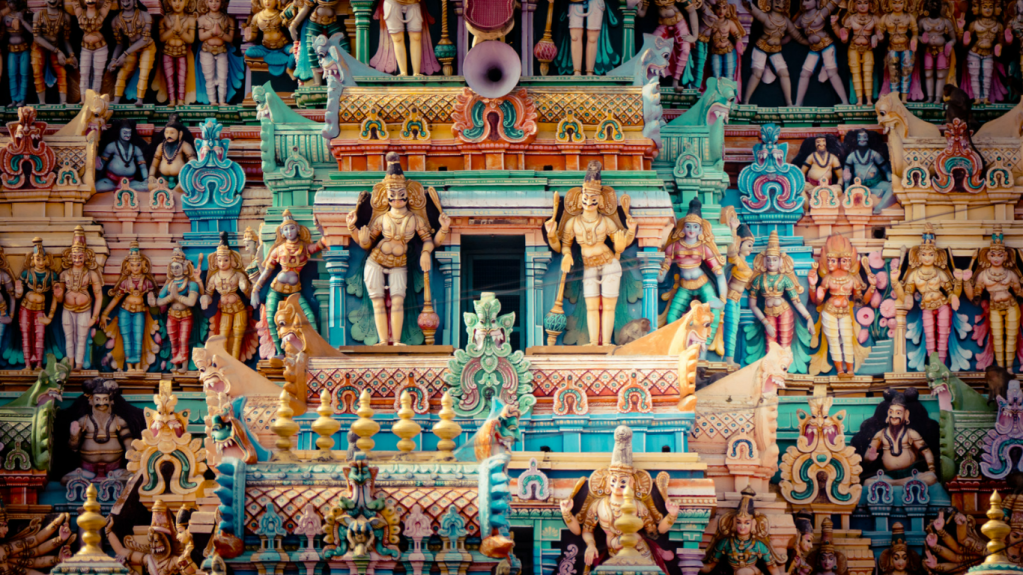
Hinduism is a rich and ancient religion that spans thousands of years and diverse cultures. It is not based on a single founder, a single book, or a single doctrine. Rather, it is a way of life that embraces various beliefs and practices.
The origin of Hinduism is not easy to trace, as it has no historical founder or date of inception. Hinduism is often considered to be the oldest living religion in the world, as it has roots in the Indus Valley civilization that existed around 2500 BCE. Hinduism is also influenced by the Aryan culture that migrated to India around 1500 BCE and by the interactions with other religions such as Buddhism, Jainism, Islam, and Sikhism.
The Aryan culture was a group of people who spoke an Indo-European language and who were thought to have settled in ancient Iran and the northern Indian subcontinent. The term Aryan was originally used as an ethnocultural self-designation by the Indo-Iranians and later became associated with a racial ideology that claimed the superiority of the white race over other races. However, this ideology has been rejected by modern scholars, who point out that the term Aryan was never used in a racial sense in ancient times, but rather as a linguistic and cultural term.
One of the key beliefs of Hinduism is dharma, which means duty, morality, or righteousness. Dharma is the ethical code that guides Hindus in their personal and social conduct. It is based on the idea that every action has a consequence and that one should act in harmony with the cosmic order.
Another key belief of Hinduism is karma, which means action or deed. Karma is the law of cause and effect that governs the cycle of rebirth or reincarnation. Hindus believe that the soul (atman) is eternal and transmigrates from one body to another according to its karma. The goal of Hinduism is to achieve liberation (moksha) from this cycle by realizing one’s true nature as Brahman, the supreme reality.
One of the core concepts of Hinduism is Brahman, the ultimate reality that transcends the physical and mental realms. Brahman is the source of all existence and the essence of everything.
But what exactly is Brahman and how can we understand it? In this blog post, we will explore the concept of Brahman from different perspectives and traditions within Hinduism, and see how it relates to our own experience of reality.
Brahman as the Absolute
The word Brahman comes from the Sanskrit root “brih”, which means to grow, expand, or swell. Brahman is thus the expansive and infinite reality that encompasses all things. Brahman is not a personal god, nor a creator, nor a being with attributes or qualities. Brahman is beyond any description, definition, or distinction. Brahman is the Absolute, the unchanging and eternal reality that underlies everything.
Brahman as the Self
One of the most profound teachings of Hinduism is that Brahman is not only the ultimate reality of the universe but also the ultimate reality of ourselves. The Upanishads, the ancient scriptures that reveal the essence of Hindu philosophy, declare: “Tat tvam asi” – “Thou art That”. This means that our true nature, our innermost self, is none other than Brahman.
How can this be possible? How can we be identical to the infinite and transcendent reality? The answer lies in understanding the difference between our apparent self and our real self. Our apparent self is our ego, our personality, and our body-mind complex. This is what we usually identify with and think of as ourselves. But this self is not real, it is only a temporary and changing phenomenon, subject to birth and death, pleasure and pain, ignorance and delusion.
Our real self is our Atman, our pure consciousness, our awareness of being. This is what we truly are, beyond any name or form, beyond any thought or feeling. This self is real, it is eternal and unchanging, blissful and wise, free and independent. This self is Brahman.
Brahman as the Godhead
Another way of understanding Brahman is to see it as the Godhead, the source and origin of all gods and goddesses. Hinduism has a rich and diverse pantheon of deities, each representing a different aspect or manifestation of Brahman. These deities are not separate from Brahman, nor are they rivals or competitors to Brahman. They are expressions or reflections of Brahman.
The most common way of categorizing these deities is by using the Trimurti, or the Trinity of Hinduism: Brahma, Vishnu, and Shiva. Brahma is the creator god, who brings forth the universe from Brahman. Vishnu is the preserver god, who sustains and protects the universe. Shiva is the destroyer god, who dissolves and transforms the universe back into Brahman. These three gods are not independent entities, but aspects or modes of Brahman.
Brahman as the All
Finally, we can also understand Brahman as the All, the totality of existence. Brahman is not only transcendent but also immanent, not only beyond but also within everything. Everything that exists is a manifestation or modification of Brahman. Nothing exists apart from Brahman.
This means that everything in the universe has a divine essence or spark within it. Everything is sacred and worthy of respect and reverence. Everything is connected and interdependent. Everything is an expression of Brahman.
Brahman is a complex and multifaceted concept that can be approached from different angles and perspectives. However, ultimately, Brahman cannot be grasped by words or concepts, but only by direct experience. As one of the Upanishads says: “Words return back along with the mind without reaching Him (Brahman). He (Brahman) alone knows His nature.” The goal of Hindu spirituality is to realize one’s identity with Brahman and attain liberation from suffering and illusion.
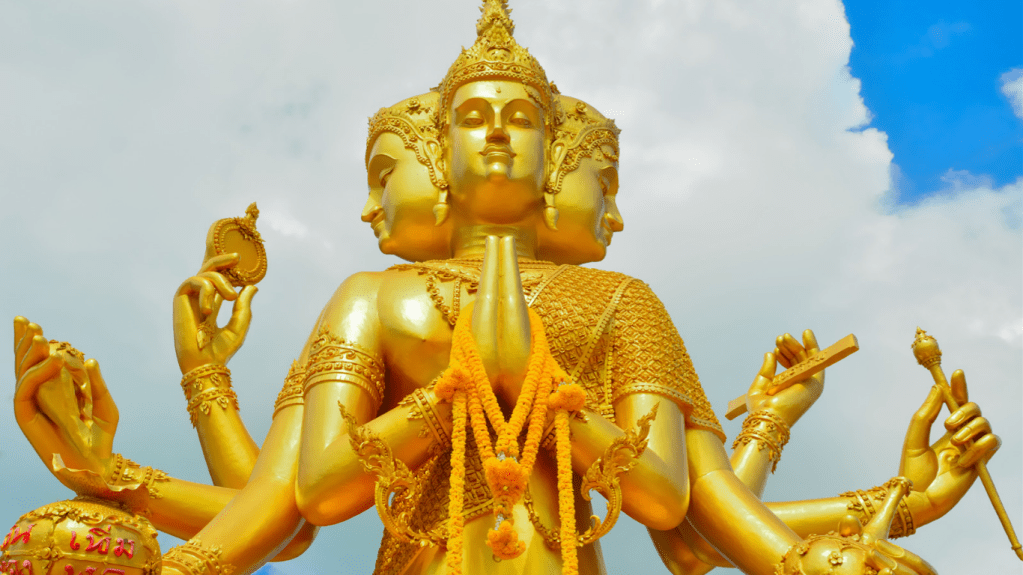
Brahma
Brahma is one of the most important deities in Hinduism, the creator of the universe and the source of all life. He is often depicted as having four heads, symbolizing his omniscience and omnipresence, and four arms, holding various objects that represent his aspects and attributes. Brahma is also associated with the Vedas, the sacred scriptures of Hinduism, and is said to have composed them with his breath.
Some of the myths and legends surrounding Brahma, as well as his role and significance in Hindu culture and philosophy. I will also discuss some of the challenges and controversies that Brahma faces in the modern world, such as his declining popularity and worship, his gender and sexuality, and his relationship with other gods and goddesses.
Brahma’s Origins and Family
There are different accounts of how Brahma came into existence, depending on the source and tradition. One of the most common stories is that he emerged from a lotus flower that sprouted from the navel of Vishnu, the preserver of the universe. Another story is that he was born from the cosmic egg that contained the primordial matter of creation. Yet another story is that he was self-born from his own mind or will.
Brahma is usually considered to be part of the Trimurti, or the Hindu trinity, along with Vishnu and Shiva, the destroyer of the universe. However, some sects and schools of thought do not accept this concept, and regard Brahma as either superior or inferior to the other two. Brahma is also sometimes identified with other deities, such as Prajapati, the lord of creatures, or Hiranyagarbha, the golden womb.
Brahma has several consorts and children, who are also prominent figures in Hindu mythology. His main consort is Saraswati, the goddess of learning, music, and arts. She is said to have emerged from his mouth or tongue, and to have helped him create the universe with her wisdom and knowledge. Brahma’s other consorts include Savitri, Gayatri, Bharati, Lakshmi, and Durga. Some of his children are Manu, the progenitor of humanity; Daksha, the father of Sati; Narada, the divine sage and musician; Sanaka, Sanatana, Sanandana, and Sanatkumara, the four mind-born sons; and Shatarupa, the first woman.
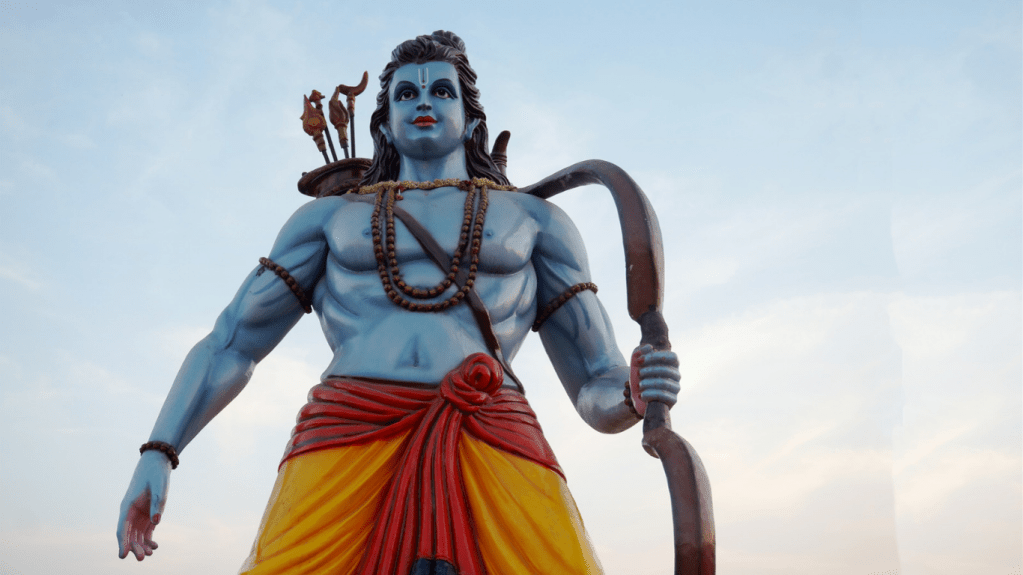
Vishnu
Vishnu is one of the most important and widely worshipped deities in Hinduism. He is the preserver and protector of the universe, who incarnates in various forms to restore balance and harmony. Some of the aspects of Vishnu, such as his attributes, his avatars, his consort, and his devotees.
Vishnu is often depicted as a blue-skinned man with four arms, holding a conch, a discus, a mace, and a lotus. He wears a yellow garment and a garland of flowers. He rests on the cosmic serpent Shesha, who floats on the ocean of milk. He is also associated with the solar symbol of the Sudarshana Chakra, which represents his power and authority. Vishnu is the supreme soul (Paramatma) who pervades all beings and all things. He is the source of all creation, preservation, and destruction.
Vishnu has many avatars, or incarnations, that he takes to intervene in the affairs of the world. Rama, Krishna, Narasimha, Varaha, and Matsya are the most famous. Each avatar has a specific purpose and a specific story. For example, Rama is the ideal king who fights against the evil demon Ravana; Krishna is the playful cowherd who teaches the Bhagavad Gita to Arjuna; Narasimha is the half-man half-lion who slays the tyrant Hiranyakashipu; Varaha is the boar who rescues the earth from the depths of the ocean; and Matsya is the fish who saves Manu from the great flood.
Vishnu’s consort is Lakshmi, the goddess of wealth, fortune, and beauty. She is also known as Shri, Padma, Kamala, and Sita. She is often depicted as a golden-skinned woman with four arms, holding lotuses and coins. She sits or stands on a lotus flower or an elephant. She is the source of all prosperity and happiness. She bestows her blessings on those who worship her and Vishnu with devotion.
Vishnu’s devotees are called Vaishnavas, who follow the path of Bhakti (devotion) to attain salvation. They worship Vishnu in various forms and names, such as Hari, Narayana, Govinda, Madhava, and Jagannatha. They chant his Names, sing his praises, listen to his stories, and celebrate his festivals. They also follow his ethical teachings and moral values. They believe that Vishnu is the supreme reality and the ultimate goal of life.
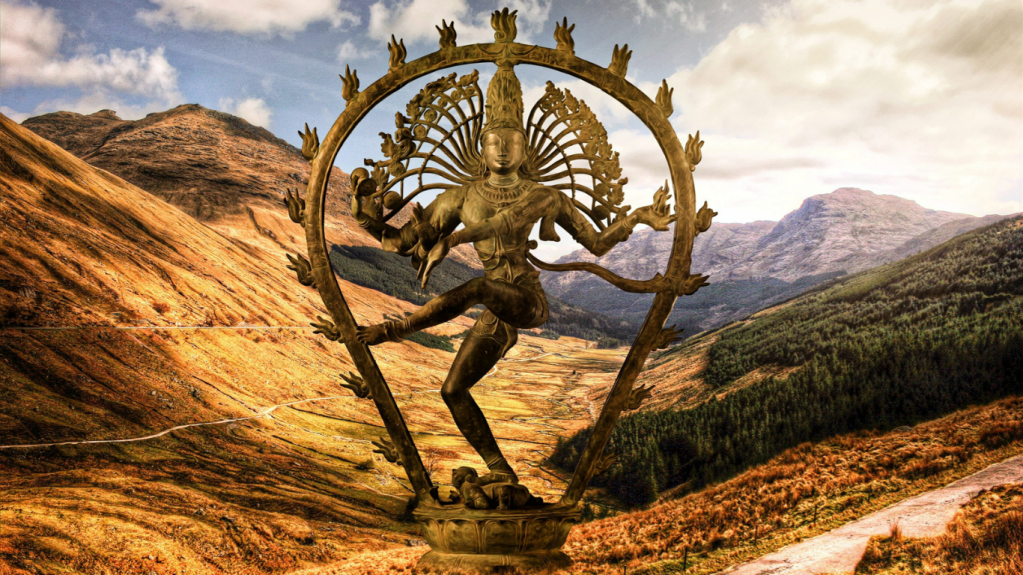
Shiva
Shiva is one of the most revered and complex deities in Hinduism. He is the supreme god of Shaivism, the largest sect of Hinduism, and is also known as Mahadeva, the Great God. Shiva has many aspects and forms, each representing a different dimension of his power and personality. He is often depicted as a three-eyed ascetic with a trident, a snake, and a crescent moon on his head. He is also associated with the cosmic dance of creation and destruction, the sacred sound of Om, and the mystical third eye of wisdom.
Some of the most fascinating and important aspects of Shiva, and how they can inspire us to live a more spiritual and meaningful life. I will also share some tips on how to worship and connect with Shiva, and how to benefit from his blessings and grace.
Shiva as the Destroyer
One of the most common and popular names of Shiva is Shiva the Destroyer. This name reflects his role as the destroyer of evil, ignorance, and illusion in the world. Shiva is not a negative or destructive force, but rather a positive and transformative one. He destroys what is old, corrupt, and stagnant, to make way for what is new, pure, and dynamic. He destroys our ego, attachments, and fears, to help us realize our true self and potential.
Shiva as the destroyer also teaches us to embrace change and impermanence in life. Nothing lasts forever in this world, except for the eternal soul. Everything else is subject to decay and dissolution. Shiva helps us to detach from our worldly possessions and relationships, and to focus on our spiritual growth and liberation. He also helps us to face our mortality and the inevitability of death, and to prepare for it with courage and faith.
Shiva as the Creator
Another name for Shiva is Shiva the Creator. This name reflects his role as the source of all creation in the universe. Shiva is not only the destroyer but also the creator. He creates everything out of his own being, out of his own consciousness. He creates through his will, his power, and his love. He creates through his dance, his sound, and his light.
Shiva as the creator also teaches us to be creative and expressive in life. We are all sparks of Shiva’s divine consciousness, and we have the potential to create our reality. We can use our imagination, our talents, and our passions to manifest our dreams and desires. We can also use our creativity to serve others and to contribute to the world. Shiva encourages us to explore our inner potential and to express it in unique and beautiful ways.
Shiva as the Preserver
A third name of Shiva is Shiva the Preserver. This name reflects his role as the protector and sustainer of all creation in the universe. Shiva is not only the creator and the destroyer, but also the preserver. He preserves what he creates with his compassion, his grace, and his mercy. He preserves the balance and harmony of nature, the order and justice of society, and the health and happiness of living beings.
Shiva as the preserver also teaches us to be compassionate and generous in life. We are all part of Shiva’s creation, and we are all connected. We should respect and care for all forms of life, from plants and animals to humans and gods. We should also share our resources and blessings with those who are less fortunate or in need. Shiva shows us how to be kind, helpful, and charitable in our thoughts, words, and actions.
 The Seeker's Lamp