
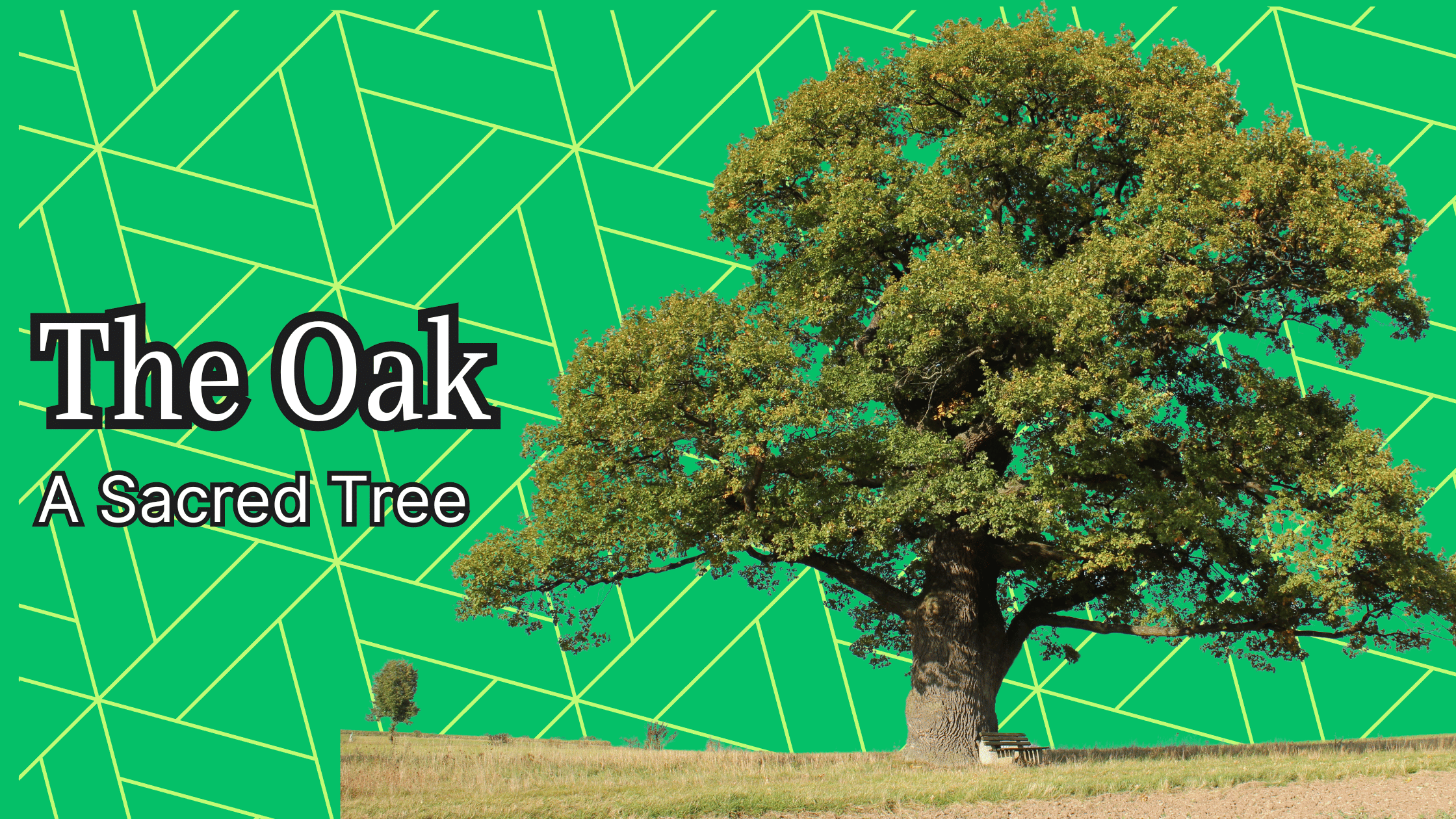
The oak tree is one of the most revered and ancient trees in the world, with a rich history and symbolism across many cultures and religions. The oak tree has strength, power, wisdom, knowledge, protection, and longevity. In this blog post, we will explore some examples and meanings of the oak tree symbolism in different belief systems and some quotes that support it.
The Oak Tree in Celtic Mythology
The oak tree is more than just a majestic plant that provides shade and timber. It is also a symbol of strength, endurance, wisdom, and courage in Celtic mythology. The oak tree was revered by the Druids, the ancient priests of the Celts, who derived their name from the word “duir”, meaning oak or door. The oak tree was seen as the door to the otherworld, the realm of spirits and ancestors, and the source of inspiration and magic.
The oak tree was associated with the supreme gods of thunder and lightning in various European cultures, such as Zeus in Greece, Jupiter in Rome, Thor in Scandinavia, and Taranis in Gaul. The oak tree was believed to be more prone to lightning strikes than other trees, and the mistletoe that grew on it was considered a sacred and powerful plant by the Druids. They harvested it with a golden sickle during a special ceremony after the winter solstice.
The oak tree was also a symbol of kingship and authority, as many ancient rulers wore crowns of oak leaves or carried oak staffs. The oak tree was thought to influence the movements of the planet Mars, which governed war and fertility. The oak tree was also a source of nourishment and healing for many animals and humans, who used its acorns, bark, leaves and wood for various purposes.
The oak tree still holds a special place in Irish culture and folklore, as it is seen as a sign of longevity, resilience, and heritage. Many place names in Ireland contain the word “dair” or “darach”, meaning oak, such as Glendalough (the valley of two lakes) or Derry (the oak grove). The oak tree is also featured in many legends and stories, such as the tale of Fionn Mac Cumhaill (Finn MacCool), who gained wisdom by eating the salmon that fed on the nuts of the nine hazels that grew around the well of wisdom under an oak tree.
The oak tree is a remarkable natural gift that deserves our respect and admiration. It is a beautiful and useful plant and a reminder of our connection to our ancestors, our spirituality and our environment.
Some quotes that reflect the Celtic symbolism of the oak tree are:
– “The oak is not felled at one stroke.” – Spanish proverb
– “The voice of the oak is like unto the voice of God.” – Irish saying
– “Be like the old oak: when all things around you fall, stand firm.” – Scottish proverb
The Oak Tree in Greek and Roman Mythology
One of the most prominent cultures that revered the oak tree was the ancient Greeks, who believed it was sacred to Zeus, their king of the gods. Zeus was the ruler of the sky, thunder, and lightning, and he often used the oak tree as his medium of communication. The oldest oracle in Greece, Dodona, was located in a grove of oaks, where priests and pilgrims would listen to the voice of Zeus through the sound of thunder or the rustling of the leaves. The oak tree also represented Zeus’s authority and justice, as the supreme judge of gods and men.
The Romans also adopted the oak tree as a symbol of their chief god, Jupiter, who was equivalent to Zeus in many aspects. The oak tree was often used to crown victorious generals and emperors, as a sign of honor and glory. The oak tree also symbolized strength and endurance, as it could withstand storms and harsh conditions.
Another interesting connection between the oak tree and mythology is the story of Orpheus, the legendary musician who could charm nature with his lyre. Orpheus was said to be the son of a muse and a king of Thrace, and he fell in love with a nymph named Eurydice. When she died from a snake bite, Orpheus descended to the underworld to bring her back, using his music to soften the hearts of Hades and Persephone. However, he failed to follow their condition of not looking back at her until they reached the upper world, and he lost her forever. In his grief, he wandered around the world, playing his lyre and avoiding the company of women. He was eventually killed by a group of maenads, who tore him apart and threw his head and lyre into a river. His head continued to sing as it floated downstream until it reached the island of Lesbos, where it was buried under an oak tree. His lyre was placed in the sky as a constellation by Zeus.
As you can see, the oak tree has many fascinating stories and meanings attached to it. It is a beautiful and useful plant, also a symbol of wisdom, power, and inspiration.
Some quotes that reflect the Greek and Roman symbolism of the oak tree are:
– “The tallest oaks have been known to grow from little acorns.” – Cicero
– “He plants his footsteps in the sea / And rides upon the storm / He treasures up his bright designs / And works his sovereign will / Ye fearful saints fresh courage take / The clouds ye so much dread / Are big with mercy and shall break / In blessings on your head / Judge not the Lord by feeble sense / But trust him for his grace / Behind a frowning providence / He hides a smiling face / His purposes will ripen fast / Unfolding every hour / The bud may have a bitter taste / But sweet will be the flower / Blind unbelief is sure to err / And scan his work in vain / God is his own interpreter / And he will make it plain.” – William Cowper
– “The groves were God’s first temples.” – William Cullen Bryant
The Oak Tree in Norse and Germanic Mythology
The oak tree is one of the most revered and ancient trees in the world. It has been a symbol of strength, endurance, wisdom, and nobility for many cultures and civilizations. In this blog post, we will explore the oak tree’s significance in Norse and Germanic mythology, and how it was associated with some of the most powerful gods and goddesses.
The oak tree was sacred to Thor, the god of thunder, lightning, storms, and fertility in Norse mythology. Thor was the son of Odin, the chief god, and Jörd, the earth goddess. He wielded a mighty hammer called Mjölnir, which he used to strike his enemies and create thunderbolts. He also rode a chariot pulled by two goats, Tanngrisnir and Tanngnjóstr.
Thor was often depicted as a red-bearded warrior with a belt of strength and iron gloves. He was the protector of Asgard, the realm of the gods, and Midgard, the realm of humans. He was also the patron of farmers, sailors, craftsmen and warriors. He was worshipped by many people across Scandinavia and Germany, especially by those who lived in rural areas or near forests.
The oak tree was believed to be Thor’s favorite tree, as it was the most resilient and majestic of all trees. It could withstand lightning strikes, strong winds, droughts and pests. It also provided shelter, food and fuel for humans and animals. The oak tree was seen as a manifestation of Thor’s power and presence on earth. People would carve runes or symbols on oak trees to invoke Thor’s protection or blessing. They would also hang offerings of food, drink, or metal on oak branches to honor him.
The oak tree was also linked to Thunar, the god of thunder in Germanic mythology. Thunar was similar to Thor in many aspects, but he had a different origin story. He was the son of Woden (Odin) and Frea (Frigg), the goddess of love and fertility. He also had a hammer called Donarshammer, which he used to fight against the giants and other enemies of the gods.
Thunar was also associated with the Gothic term Fairguni, which means “oak god”. This suggests he was originally a nature deity who presided over oak groves and forests. Thunar was revered by many Germanic tribes. Such as the Franks, Saxons, Angles, and Lombards. He was also connected to Tiwaz (Tyr), the god of war and justice, and Ziu (Ziu), the god of the sky.
The oak tree was not only a symbol of Thor and Thunar, but also of other gods and goddesses in Norse and Germanic mythology. For example:
– Odin, the god of wisdom, poetry, magic, and death, hung himself from an oak tree for nine days and nights to gain knowledge of the runes.
– Freyja, the goddess of love, beauty, fertility, and war, had a chariot drawn by two cats that were born from an oak tree.
– Frigg, the goddess of marriage, motherhood and domesticity, wove clouds from oak wool.
– Idunna, the goddess of youth and immortality, kept golden apples in an oak chest that she gave to the gods to renew their vitality.
– Ullr, the god of hunting, skiing and archery, had a bow made from an oak branch.
– Skadi, the goddess of winter, snow, and mountains, had skis made from oak wood.
The oak tree was also a symbol of royalty and nobility in Norse and Germanic culture. Many kings and queens wore crowns or wreaths made from oak leaves or acorns to show their authority and connection to the gods. They also held ceremonies or rituals in oak groves or under oak trees to celebrate important events or seek divine guidance.
The oak tree was also a source of inspiration and creativity for poets, artists and craftsmen. They used oak wood to carve statues, furniture, or musical instruments. They also used oak bark to make ink or dye for writing or painting. They also used oak galls to make black pigment for tattoos or cosmetics.
The oak tree was a remarkable tree that played a vital role in Norse and Germanic mythology and culture. It was a symbol of strength, endurance, wisdom, and nobility that inspired awe and reverence among humans and gods alike. It was also a symbol of life, fertility and abundance that provided sustenance and comfort for many living beings. It was indeed worthy of being called “the king of trees”.
Some quotes that reflect the Norse and Germanic symbolism of the oak tree are:
– “From a withered tree a flower blooms.” – Buddha
– “He who plants an oak looks forward to future ages.” – Horace
– “Mighty oaks from little acorns grow.” – English proverb
The Oak Tree in Slavic and Baltic Mythology
The oak tree in Slavic and Baltic mythology, where it was associated with the highest god of thunder and the world tree.
In Slavic mythology, the highest god of the pantheon was Perun, the god of sky, thunder, lightning, storms, rain, law, war, fertility and oak trees. He was worshipped as a mediator between heaven and earth, and his attributes were fire, mountains, wind, eagle, hammer, axe, and arrow. He was often depicted as a bearded man with a golden mustache, holding a hammer or an axe. His sacred animal was the eagle, which perched on the top of the world tree.
The world tree in Slavic mythology was usually an oak, which represented the order and harmony of the cosmos. The oak tree had three parts: the roots, which connected to the underworld where the dead ancestors dwelled; the trunk, which represented the present life of humans and animals; and the branches and leaves, which symbolized the offspring and future generations. The oak tree was also a source of wisdom and immortality, as it was believed to contain the fire of life within its core.
The oak tree was also sacred to Perun’s Baltic counterpart, Perkūnas, the god of thunder, lightning, storms, rain, law, war, fertility, and oak trees. In his attributes and symbols, he was similar to Perun, but he had a horned helmet and rode a chariot pulled by goats. He also had a rivalry with Velnias, the god of the underworld and death, who often tried to steal his fire or his wife. Perkūnas would chase him with his thunderbolts and strike him down.
The oak tree was also the world tree in Baltic mythology, which connected the three realms of heaven, earth, and underworld. It was also a symbol of Perkūnas’ power and authority over nature and human affairs. The oak tree was believed to be inhabited by spirits and deities, who could grant blessings or curses to people. The oak tree was also a place of worship and sacrifice for Perkūnas and other gods.
The oak tree in Slavic and Baltic mythology was not only a plant, but a living being with a soul and a spirit. It was a manifestation of the divine force that ruled over the world and its elements. It was a source of life, wisdom, and protection for humans and animals. It was a sacred tree that deserved respect and reverence.
Some quotes that reflect the Slavic and Baltic symbolism of the oak tree are:
– “An old man planted an acorn in the ground / And said as he planted it: ‘I plant this acorn along with hope.’ / And hope did not perish through long time passed away / And storms swept over it day after day.” – Ivan Franko
– “A good man is like a good tree. His roots are deep, his branches are high, and his fruits are sweet.” – Lithuanian proverb
Keep Seeking!
Leave a Reply